
Hello, everyone! I’m “Pudding🍮” from the Business Development Department.
In this post, I’ll introduce the different types of generative AI—which is constantly evolving—and share some tips on how to use it effectively.
We operate an e-commerce site for international customers called “Dandelions Japan.”
We actively utilize AI for our social media management and video production.
For example, we use AI to generate ideas for posts and draft content, allowing us to efficiently create engaging material. We also leverage AI for image and video assets, which helps us produce high-quality visuals while reducing the time previously required for these tasks.
Types of Generative AI
While we often use the term “AI” as a general umbrella term, there are actually many different types.
Tools specialized for specific purposes—such as text-generation AI, image-generation AI, video-generation AI, and music-generation AI—are emerging one after another. Since each has its own areas of expertise, it’s important to choose the right one for your specific needs.
For example, by choosing the right tools—such as text-generating AI for writing and image-generating AI for visual design—you can achieve results more efficiently.
Specifically, ChatGPT is a leading example of text-generating AI, capable of handling a wide range of tasks such as brainstorming, writing, and summarizing.
Another example of image-generating AI is Midjourney, which can generate high-quality illustrations and photo-realistic images simply by entering text prompts.
In the field of video production, video-generating AI is being used to create videos from images and text, significantly contributing to more efficient production workflows.
In addition, there is Suno, a music-generating AI that allows you to create original songs simply by describing the desired mood in text.
Since each AI has its own areas of expertise, you can create higher-quality content by selecting the right one for your specific needs.

How to Write Effective Prompts
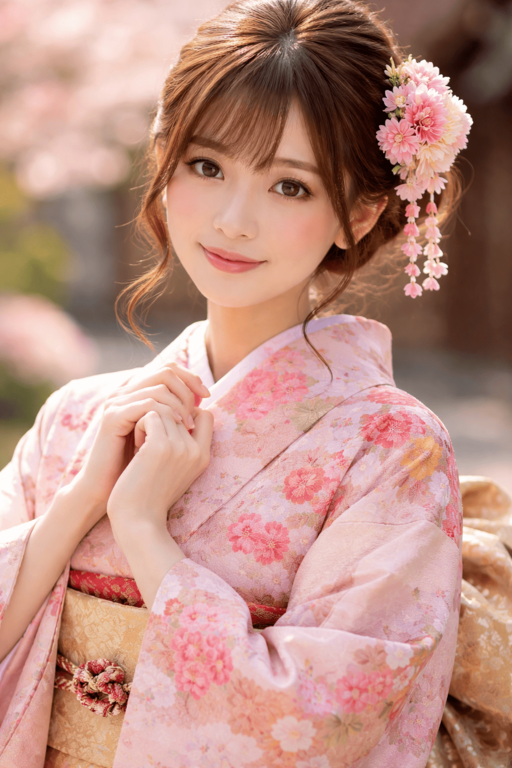
When using generative AI, one of the most important factors is how you write your prompts. Since generative AI generates results based on the input provided, ambiguous instructions will not yield the desired results. For example, when generating images, a simple prompt like “a woman in a kimono, cute” may lack specificity, resulting in an image that doesn’t match your vision.
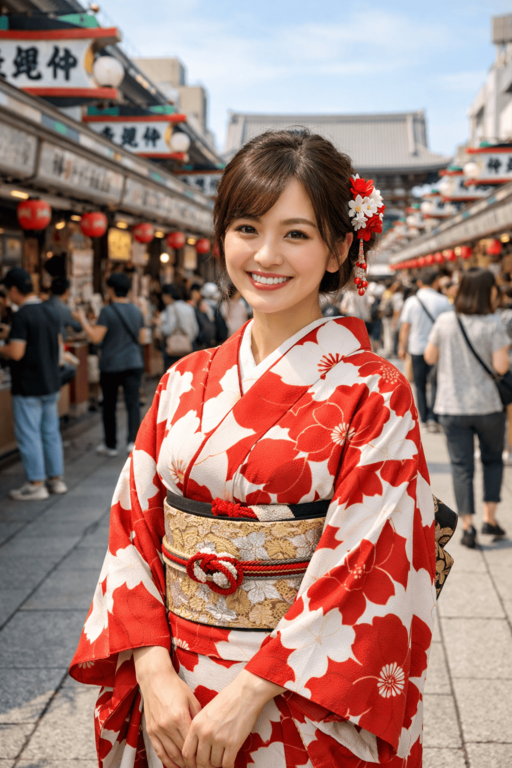
On the other hand, by describing the subject, location, situation, and atmosphere in concrete terms—such as “A Japanese woman in her 20s, wearing a red and white kimono, stands smiling on Nakamise Street in Asakusa. The natural daylight creates a realistic look, just like in a photograph”—
you can achieve results that are closer to your ideal.
So, how should we approach prompts like this?
Actually, the example from earlier can be broken down into the following elements.
・Subject (Who/What)
Specify exactly what you want to draw (e.g., a Japanese woman in her 20s)
・Action/Situation (What)
Clearly describe what the subject is doing (e.g., standing with a smile)
・Location/Background (Where)
Specify the setting of the scene (e.g., Nakamise Street in Asakusa)
・Artistic Style
Specify the style of the drawing (e.g., realistic, like a photograph)
・Photography / Realism
Emphasize the level of realism (e.g., natural light, photorealistic)
・Camera / Angle
Specify the angle and composition (e.g., close-up, wide-angle, etc.)
・Specifying Unnecessary Elements
Exclude elements you do not want to be generated in advance (e.g., blurry images, low-quality images, text, watermarks, etc.)
Word order is even more important. Since the AI tends to place greater emphasis on elements mentioned earlier in the prompt, it’s crucial to list the most important elements—such as the subject—first.
Recently, as the accuracy of generative AI has improved, it’s now possible to get decent results even with relatively simple instructions. However, to achieve higher-quality results or output that more closely matches your vision, it’s important to design your prompts with these factors in mind.
By taking a little extra time to write specific instructions, you can maximize the potential of generative AI. If you keep these points in mind, you’ll be able to generate images that match your vision!
Summary
Generative AI is an incredibly useful tool that can significantly boost productivity and expand creative possibilities, depending on how it’s used. However, it’s not enough to simply use it; choosing the right tool and crafting effective prompts are also crucial.
We, too, will continue to leverage generative AI while keeping these points in mind, striving to create even better content.
We hope this information will be helpful to those who are interested in trying generative AI.
That’s all for today.
Thank you for reading.
Stay tuned for our next Engineer Blog post!